The World’s Largest Sustainable City in the Heart of the Desert: How Dubai Reconciles with Nature
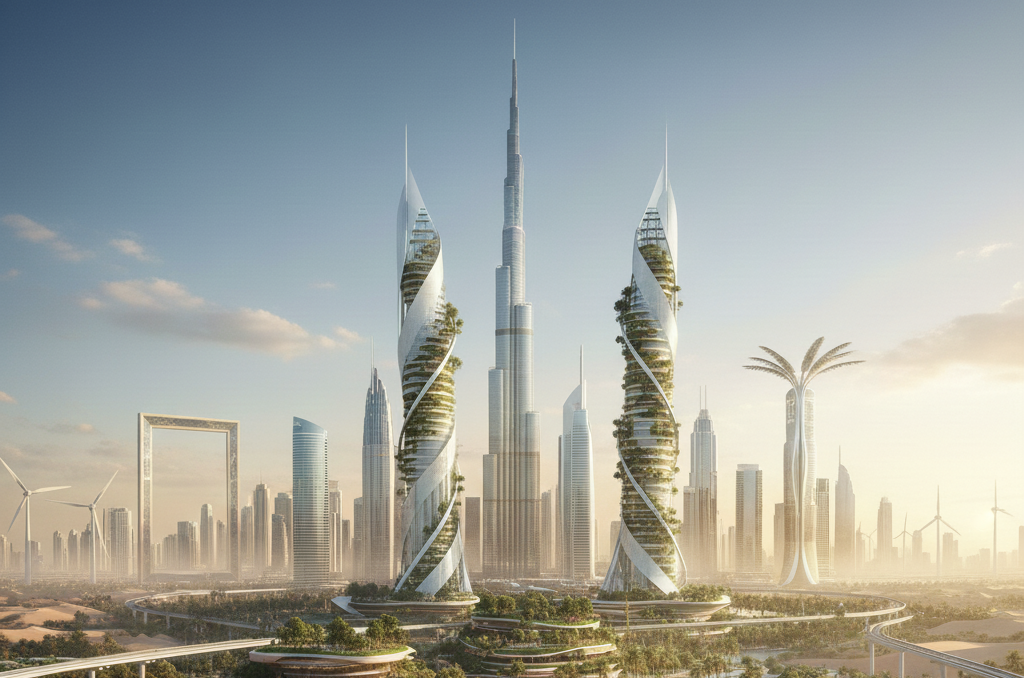
Dubai, a metropolis known globally for its soaring skyscrapers and daring projects, is now fundamentally redefining the concept of 21st-century living. While the traditional image of a desert is one of absolute aridity and stifling heat, Dubai has proven through its pioneering “The Sustainable City” project that even in the harshest climatic conditions, a lasting peace with nature is achievable. This project is more than just beautiful architecture; it is a manifesto for the future of human survival in arid regions.
Dubai’s Sustainable City: A Dream That Germinated in Shifting Sands
This massive project is not merely a luxury residential complex; it is a “living ecosystem” and a smart hub designed to tackle the challenges of climate change. The Sustainable City in Dubai is recognized as the first operational Net Zero Energy community in the entire Middle East. In this project, engineers have combined indigenous knowledge with modern technology to build a city that aims not only to minimize the carbon footprint but also to maximize the quality of life and the psychological well-being of its residents in the long term.
The “Zero” Strategy: How Dubai Made Electricity Bills Disappear
One of the most dazzling aspects of this city is its complete independence from traditional power grids and its maximum utilization of the desert’s vast solar potential.
Photovoltaic Infrastructure: In this city, no surface is wasted. All rooftops, parking canopies, and even parts of the walkways are covered with advanced solar panels that generate clean energy around the clock.
Passive Design: Homes are built based on precise solar orientation. The use of highly insulated walls and double-glazed windows with UV coatings allows natural light to enter while keeping infrared heat out. This smart design has drastically reduced the buildings’ thermal load, cutting the need for energy-intensive air conditioning by up to 50%.
Agriculture in the Heart of the Desert: Bio-Domes
Ensuring food security in the middle of a desert has always been a major challenge, but Dubai has addressed this need by designing 11 giant Bio-Domes situated along the city’s “Green Backbone.” In these domes:
Soilless Cultivation Technology: Advanced hydroponic and aeroponic methods are used, reducing water consumption by up to 90% compared to traditional agriculture.
Short Supply Chain: Organic products—ranging from leafy greens to tropical fruits—are produced directly in the heart of the city and provided to residents without the need for heavy packaging processes or costly road transport. This means “farm to table” in just a few minutes.
Closed Water Loop: Every drop of water that evaporates in these domes is recaptured by condensation systems and returned to the irrigation cycle.
Smoke-Free Transport: Where Gasoline Cars Are Forbidden
In Dubai’s Sustainable City, the pattern of urban mobility has been completely transformed. There is no roar of gasoline engines, no exhaust fumes, and no chemical pollution.
Car-Free Zones: Residential areas are entirely pedestrian-oriented. Gasoline-powered cars are not allowed into the alleys and are parked in solar-powered lots on the periphery of the city.
Electric and Autonomous Fleet: Internal mobility is facilitated by smart, free electric shuttles charged by solar energy.
Active Mobility: Walking and cycling paths are designed such that, through vegetation and shade-providing architecture, they maintain a lower temperature than the surrounding environment even in the peak of summer heat, encouraging residents to stay active.
Circular Economy: Turning Waste into Wealth
In this city, the concept of “trash” has been completely eliminated and replaced by “valuable resources.” Sustainability here means the meticulous management of everything consumed.
Smart Sorting: Advanced waste sorting systems at the source prepare plastic, glass, and metal for industrial recycling.
Bio-Fertilizer Production: All organic waste from restaurants and homes is transferred to composting machines and turned into rich fertilizer to nourish the city’s greenery and gardens.
On-site Wastewater Treatment: Gray and black water are treated through plants and natural filters and used to irrigate more than 10,000 palm trees and public green spaces; thus, the city places no pressure on the country’s freshwater resources.
Reconciling with Nature: The Psychological Impact of Green Living
Beyond the technical aspects, The Sustainable City is a human project. Environmental research shows that residents of this area experience significantly lower levels of stress and anxiety compared to typical Dubai urbanites due to constant contact with nature.
The presence of artificial wetlands that have become habitats for migratory birds, along with the soothing silence of the environment (due to the elimination of cars), has created a unique atmosphere. This city proves that sustainability is not just about preserving resources but about restoring peace and a sense of belonging to one’s living environment.
Is This Model Replicable?
By successfully implementing this project, Dubai has provided a global “roadmap” for the cities of the future in arid regions. This model demonstrates that sustainability is not a luxury or a fantasy, but the only way for large cities to survive in the era of climate change. The success of this city has led to even larger projects, such as “Sustainable Sharjah” and “Masdar City” in Abu Dhabi, accelerating their path toward green development based on the lessons learned here.
Dubai 2030: A Journey into the Hidden Layers Tourists Don’t See
Conclusion: The Future is Here
Dubai proved to the world that saving the planet does not require a retreat to pre-industrial times; rather, it requires embracing green technologies with open arms. The Sustainable City sends a bold message to humanity: if a completely green, self-sufficient, and vibrant city can be built amidst the hot sands of one of the driest places on Earth, then there is no excuse for not changing elsewhere in the world. The future in Dubai is no longer a dream; it is a tangible reality.
Dubai: The World’s Living Laboratory; From Flying Taxis to Robotic Police