Religious Coexistence in Dubai: From the Call to Prayer to Church Bells and Magnificent Temples
Dubai is not just a city of glass skyscrapers and luxury shopping malls; it is the beating heart of cultural and religious diversity in the Middle East. As a showcase of the modern world, Dubai has successfully intertwined Islamic traditions with international living. If you are planning to migrate, travel, or invest in this city, understanding the state of religion and freedom of belief is a key pillar to knowing Emirati society. The city hosts over 200 different nationalities, each bringing their own religious and cultural heritage to this land, finding a space to breathe within a cohesive legal framework.
Islam in Dubai: The Official Religion with a Global and Open Approach
Islam is the backbone of the UAE’s culture, laws, and social structure. Contrary to many misconceptions, Islam in Dubai is practiced with a very moderate approach, aligned with the needs of a global city. This approach has allowed Islam to act not as a barrier, but as a gracious host to other religions.
Mosques: Beyond Places of Worship: Dubai’s mosques are architectural masterpieces that showcase a blend of traditional Islamic art and modern engineering. The “Jumeirah Mosque,” as one of the most beautiful, operates under the “Open Doors, Open Minds” program by the Sheikh Mohammed Centre for Cultural Understanding (SMCCU). In these programs, tourists and non-Muslim residents not only visit the architecture but also participate in candid Q&A sessions where any ambiguity about Islam—from the hijab to prayer—is answered with patience. The goal is to break down cultural barriers and build a bridge between followers of different faiths.
Impact of Islam on Civil Laws and Recent Reforms: Although the laws are based on Sharia, Dubai has undertaken major reforms in recent years that demonstrate the dynamism of jurisprudence in the face of the modern world. For example, laws regarding inheritance and divorce for non-Muslims can now be executed based on the laws of their home country. This means a European citizen living in Dubai can draft their will according to their country’s laws, and Dubai courts will recognize it. This level of legal flexibility has provided unparalleled psychological security for expatriates.
Respect for Ramadan in the Modern Era: Ramadan in Dubai is a blend of spirituality and nightly festivals. While in the past, eating and drinking in public carried heavy fines, today most restaurants and cafes continue to operate using partitions or even completely openly in some areas. The city comes alive after Iftar; Iftar and Suhoor tents host not only Muslims but also non-Muslims who want to enjoy traditional foods and the warm, friendly atmosphere of this month. This “dining diplomacy” is one of the strongest social bonds in Dubai.
Christianity in Dubai: A Mosaic of Denominations and Traditions
The Christian community in Dubai is one of the most active and diverse religious groups in the city. From Filipino and Indian Catholics to European Protestants and Lebanese or Greek Orthodox, all have dedicated spaces for themselves.
The Jebel Ali Religious Complex: The Village of Religions: The Dubai government, with political foresight, has allocated a vast area of land in the Jebel Ali district for the construction of non-Muslim religious centers. This area is now recognized as a symbol of coexistence.
St. Francis of Assisi Catholic Church: Due to the massive Catholic population, this church welcomes thousands daily. Religious services here are held in over 10 languages, including English, Arabic, Tagalog, Hindi, and French.
Denominational Diversity: In the same area, Anglican churches, the Coptic Orthodox Church (belonging to Egyptians), and Protestant centers are located within a very short distance of each other. This concentration has allowed followers of different Christian denominations to remain in constant interaction.
Urban Manifestations of Christianity: During Christmas and Easter, Dubai becomes one of the brightest cities in the world. Giant Christmas trees in “Mall of the Emirates” and “Dubai Mall,” and Christmas carol concerts at the “Dubai Opera,” show the full acceptance of these occasions in the city’s public spaces. Interestingly, many Muslims also participate in these celebrations and exchange gifts with their Christian friends.
Hindu and Sikh Temples: An Unbreakable Bond with the Subcontinent
Given that a large portion of Dubai’s workforce, traders, and investors are from India and South Asian countries, Eastern religions hold a historical and strategic place in this city.
Magnificent Hindu Temple in Jebel Ali: Opened in October 2022, this temple is a masterpiece of white marble. Its architecture blends traditional Indian styles with modern Arabic elements. The presence of 16 deities in this temple shows respect for all branches of Hinduism. The Dubai government not only donated the land for this temple, but high-ranking officials also attended its opening ceremony to broadcast a message of peace and welcome to the world.
Gurudwara (Guru Nanak Darbar): This Sikh temple in Jebel Ali is more than just a religious site; it is a social service center. The tradition of “Langar,” where hot, free meals are given to anyone regardless of religion, race, or financial status, is practiced with special grandeur in Dubai. This center holds ISO certifications for food safety and management, demonstrating the fusion of religious traditions with Dubai’s modern standards.
Shiism and the Status of Shias: Deep Roots and Mutual Respect
Shias, especially Iranian, Bahraini, and Subcontinental Shias, are among the oldest residents and traders of Dubai who have played a significant role in the city’s development.
- Worship and Cultural Centers: The “Imam Ali (AS) Mosque” in the Jumeirah area, with its authentic Iranian azure tilework, is one of the city’s most prominent religious buildings. In addition to offering prayers, this mosque serves as a cultural center for promoting the teachings of the Ahl al-Bayt (AS). Furthermore, numerous Husseiniyas exist in the older parts of the city like “Bur Dubai” and “Deira,” which have been active for decades.
- Freedom of Ceremony and Security: During the first ten days of Muharram and the days of Ashura and Tasua, Shias in Dubai hold their ceremonies with complete security inside Husseiniyas and religious centers. The Dubai Police not only secure these centers but also assist in the smooth running of the ceremonies by managing traffic and providing necessary facilities. This level of respect for Shia mourning in a predominantly Sunni country is renowned in the region.
The Abrahamic Family House and the Acceptance of Judaism
One of the newest and boldest steps by the UAE toward religious pluralism is the acceptance and formal recognition of the Jewish community.
The Abrahamic Family House Project: Although the main complex is in Abu Dhabi, the spirit of this project prevails in Dubai. The complex, which includes a mosque, a church, and a synagogue in one enclosure, carries a global message about the common roots of monotheistic religions.
The Jewish Community of Dubai: Following the Abraham Accords, Jews in Dubai now have official synagogues. Numerous restaurants in Dubai have received “Kosher” certification, and you can even find Kosher-compliant food in the Burj Khalifa, the world’s tallest building. Jewish festivals like “Hanukkah” are now celebrated in Dubai’s public spaces with the presence of local officials.
Legal Frameworks: Guaranteeing Order and Respect
The religious security and stability of Dubai are not accidental; they are the result of precise laws and continuous supervision.
Anti-Hate and Discrimination Law: In Dubai, insulting any religion, from Abrahamic faiths to Eastern religions, is considered a crime. Using derogatory religious terms online or in person can lead to deportation, heavy fines (up to millions of Dirhams), and imprisonment. This law has ensured that individuals with completely opposing beliefs interact with each other with respect in the workplace and in life.
Educational System: Private schools in Dubai, which implement the national educational systems of various countries, are allowed to promote their culture but are all required to teach the values of “tolerance” and “respect for others.” This ensures that a new generation of Dubai residents is raised seeing diversity as an advantage, not a threat.
Prohibition of Proselytization: The thin line of religious freedom in Dubai is non-interference in the religion of others. Any organized effort to convert Muslims or using financial and promotional tools to attract new followers is a red line for the government. This policy is adopted to preserve the traditional fabric of society and prevent sectarian tensions.
Frequently Asked Questions (FAQ) about Religion in Dubai
Is there a church in Dubai and where is it?
Yes, Dubai has dozens of churches. The main complex is in the Jebel Ali area, which includes Catholic, Anglican, Coptic, and other churches. There are also churches in the Oud Metha area.
Are non-Muslims allowed to enter mosques?
Usually, mosques are for Muslim worshippers, but mosques like the “Jumeirah Mosque” have special programs for non-Muslim visitors to learn about Islamic culture.
Is it forbidden to wear specific religious clothing (like a cross or turban) in the street?
No, followers of all religions are free to wear their religious symbols. Sikhs with turbans, Christians with crosses, and Hindus with their religious marks move around the city without any issues.
Where do Iranian Shias hold religious ceremonies?
The main center for Iranian Shias is the “Imam Ali (AS) Mosque” in Jumeirah. Additionally, old Husseiniyas in “Bur Dubai” and “Deira” host religious ceremonies for Iranians.
What are the Ramadan rules for tourists?
Tourists are not required to fast. Most restaurants are open during the day. It is only recommended to avoid eating, drinking, and smoking in very crowded public spaces to respect local culture.
Is there a temple for Hindus in Dubai?
Yes, a large new Hindu temple has opened in the Jebel Ali area. There are also older temples in the “Bur Dubai” area (near the Dubai Museum) that have been active for decades.
Can one buy non-Islamic religious books in Dubai?
Yes, large bookstores in Dubai sell the holy books of various religions, including the Bible and the Torah, in different languages.
What happens if someone insults another religion in Dubai?
The UAE government has a “zero tolerance” policy for religious insults. The offender may face heavy fines, imprisonment, and permanent deportation.
Is there a synagogue for Jews in Dubai?
Yes, several Jewish worship centers are currently active in Dubai, and official synagogues operate under government supervision.
Do Dubai schools have religious classes for non-Muslim students?
Muslim students take “Islamic Education,” but for non-Muslims, “Moral Education” classes are usually held, focusing on universal values.
Final Conclusion
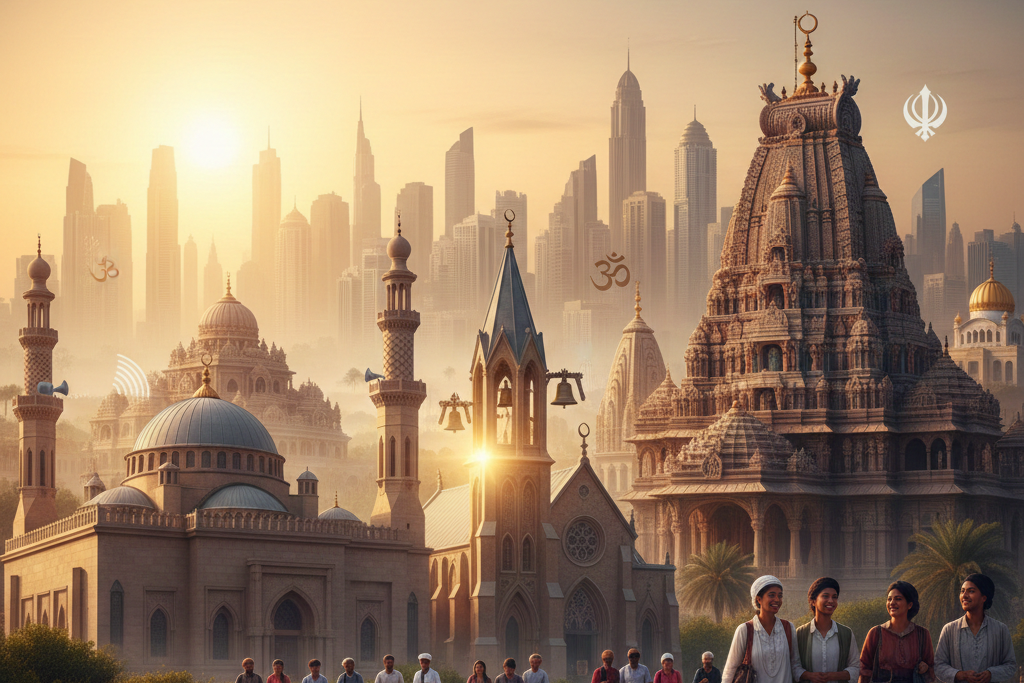
By replacing “confrontation” with “interaction,” Dubai has created a model where the sound of church bells does not interfere with the call to prayer; instead, both are part of the symphony of a global city. This city has proven that it is possible to open its arms to the whole world while maintaining its Islamic identity. Religious tolerance in Dubai is not a slogan but a legal and social structure that allows every human being to live in peace, security, and respect. This coexistence is one of the greatest intangible assets that has made Dubai a popular destination for people all over the world.