Dubai: The World’s Living Laboratory; From Flying Taxis to Robotic Police
Dubai is no longer just a city of sky-high towers and luxury shopping malls; it has now transformed into a global “Living Lab.” This is a place where daring scientific hypotheses and sci-fi dreams turn into everyday realities before they gather dust in books. From commuting through the mid-layers of the sky using clean energy to the presence of intelligent robots in social interactions, Dubai is meticulously drawing the roadmap for 22nd-century human life. The city doesn’t just adopt technology; it redefines it within the context of urban living.
Mobility in the Heights: When Dubai’s Sky Becomes a Street
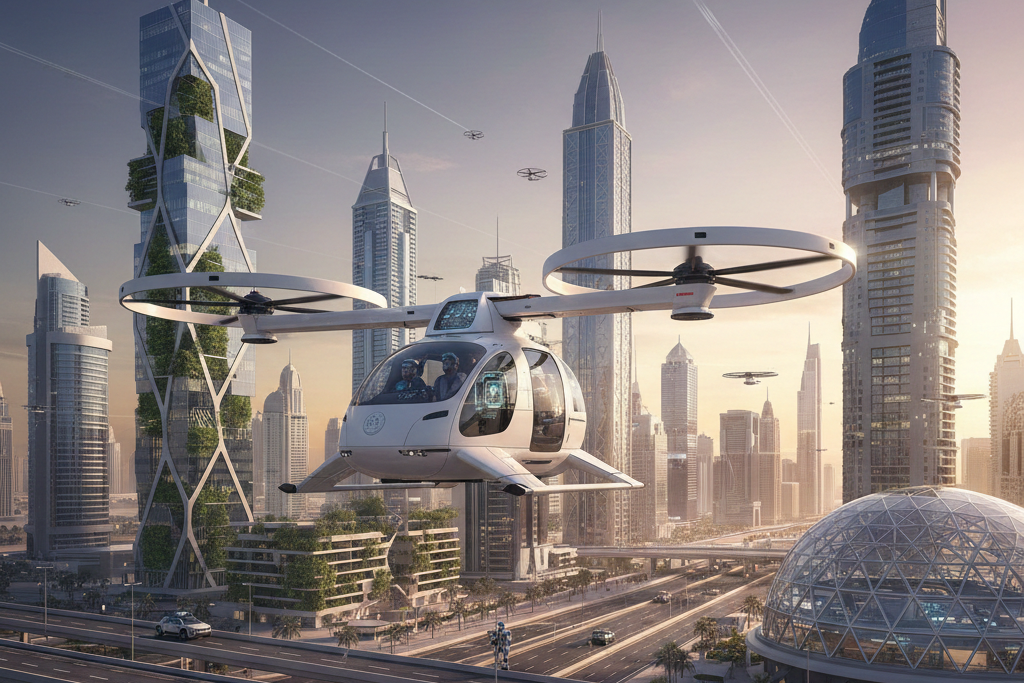
One of Dubai’s most ambitious infrastructure projects is the operationalization of an eVTOL (electric Vertical Take-Off and Landing) flying taxi network. In collaboration with global industry pioneers, Dubai is determined to launch the world’s first commercial vertical mobility service by 2026.
A Revolution in Time and Traffic: These electric vertical-flight vehicles will shift the city’s temporal equations. For instance, a journey that takes 45 minutes to an hour on the ground during peak traffic will be covered in just 6 minutes via aerial routes. This not only boosts time productivity but also relieves traffic pressure from major highways like Sheikh Zayed Road.
The Vertiport Network: Unlike traditional airports, Dubai is building small, smart stations called “Vertiports” at strategic points across the city. These stations are being established near Dubai International Airport, Downtown Dubai, Palm Jumeirah, and Dubai Marina to create a connected, seamless network for passengers moving between major economic and tourist hubs.
Sci-Fi Style Security: Robotic Police and AI
In Dubai, the concept of security goes beyond the physical presence of police officers. The Dubai Police Force has invested heavily in the Internet of Things (IoT) and Artificial Intelligence, presenting a new face of law and order:
Patrol and Interactive Robots: Dubai’s police robots are not just for show; they are equipped with advanced facial recognition cameras and thermal scanners that can navigate through crowds to identify wanted individuals or suspicious behavior. These robots feature touch panels through which citizens can report crimes or pay fines.
Hoverbikes: The experimental use of hoverbikes for rapid response teams allows police to reach incident sites during crises without traffic constraints, utilizing aerial shortcuts. This technology is specifically designed for accessing high-altitude points or crowded areas.
Predictive Policing: Using AI algorithms, Dubai analyzes crime data from previous years to identify potential future patterns. This system allows the police to deploy forces to areas where the probability of an incident is high before a crime even occurs.
Autonomous Transportation: Dubai’s 2030 Strategy
Dubai’s Autonomous Transportation Strategy has a simple yet transformative goal: by 2030, 25% of all urban trips must be driverless. This initiative is expected to save approximately 900 million AED in transportation costs annually and significantly reduce environmental pollution.
Smart Public Transit Systems: Autonomous minibuses and shuttles are already active in limited experimental zones. These vehicles use LiDAR sensors and precise radar to scan their surroundings and navigate designated routes with millimeter precision.
The Hyperloop Project: Dubai is pursuing the implementation of a vacuum-tube transport system. With the Hyperloop, the journey between the two economic hubs of the UAE—Dubai and Abu Dhabi—which normally takes over an hour, will be reduced to less than 12 minutes. This technology, traveling at speeds exceeding passenger jets, shatters geographical boundaries.
3D Printing: The Miracle of Modern Architecture
Dubai isn’t just seeking smart gadgets; it intends to revolutionize the global construction industry. According to official statements, by 2030, one in every four new buildings in Dubai will be constructed using 3D printing technology.
The World’s First 3D-Printed Office: Dubai previously proved this idea was viable by building the “Office of the Future.” Every component of this building was layered and constructed by a giant printer. This approach allows architects to easily execute complex, curved forms that were impossible or prohibitively expensive with traditional methods.
Economic and Environmental Efficiency: 3D printing reduces the need for human labor in hazardous construction tasks by up to 50%. Furthermore, construction waste is minimized, marking a significant step toward environmental sustainability and reducing final housing costs for citizens.
Dubai 2030: A Journey into the Hidden Layers Tourists Don’t See
Dubai: A Destination for Geniuses and Tech Startups
The question remains: why is such a volume of innovation concentrated in Dubai? The answer lies in the city’s supportive ecosystem. By offering 10-year “Golden Visas” to scientists, coders, and entrepreneurs, Dubai is attracting the world’s brightest minds.
Specialized Free Zones: Areas like DIFC (Dubai International Financial Centre) and Dubai Internet City offer flexible regulations and tax exemptions, providing an ideal environment for tech giants like Google and Microsoft, as well as blockchain and AI startups, to test and develop their products. Dubai has positioned itself as a “Sandboxing” hub where regulations change rapidly to align with new technologies.
Frequently Asked Questions (FAQ)
1. When will the Dubai flying taxi service officially launch?
According to the Dubai Roads and Transport Authority (RTA), the first commercial network of electric flying taxis is expected to launch by early 2026.
2. Will robotic police replace human officers?
No; the aim of employing robotic police is not complete replacement, but rather to assist human forces in routine patrols, facial recognition in crowded areas, and providing rapid services to citizens in tourist locations.
3. How much will a Hyperloop trip between Dubai and Abu Dhabi cost?
While an exact price hasn’t been announced, Dubai authorities have stated their goal is to keep prices competitive with other forms of public transport to ensure accessibility for the general public.
4. What is the main advantage of 3D-printed buildings in Dubai?
Beyond creative designs, these buildings are constructed much faster (up to 70% faster) with significantly less construction waste, leading to substantial cost reductions and environmental preservation.
5. How can a tech specialist work in Dubai?
Through the “Golden Visa” and “Virtual Work Visa” programs, Dubai has made it easier for AI specialists, programmers, and entrepreneurs to live and work in the city without the need for a local sponsor.
The World’s Largest Sustainable City in the Heart of the Desert: How Dubai Reconciles with Nature
Conclusion
Dubai is crossing the traditional boundaries of urbanization at a breathtaking pace. In this city, technology is not just a tool for showing power; it is a solution for enhancing welfare, increasing public safety, and ensuring environmental survival in harsh climatic conditions. Dubai shows the world that the future isn’t sold—it’s built. To see how humanity will live in the second half of this century, you no longer need to watch Hollywood movies; you just need to walk the streets of Dubai.