Can Dubai Truly Become the World’s First AI-Driven City by 2030?
Dubai is no longer merely chasing the tallest skyscrapers or man-made islands; the emirate’s new objective is a fundamental redefinition of “citizenship” and “governance” in the post-digital era. The Dubai AI 2030 Strategy, coupled with the goal of complete paperless government cycles, is not just political ambition—it is a structural paradigm shift in the region’s economic ecosystem. This comprehensive analytical report explores the hidden layers, technical infrastructure, geopolitical challenges, and unparalleled opportunities for tech startups on this journey.
The Roadmap: From “Paperless Government” to “Anticipatory Smart Governance”
In December 2021, Dubai officially announced its status as the world’s first 100% paperless government. This achievement meant the elimination of over 336 million sheets of paper annually, saving 1.3 billion AED (approximately $350 million). However, this success was merely the “foundation” for a far grander project. The primary phase involves injecting Artificial Intelligence into the underlying layers of urban infrastructure so that the city functions not just “digitally,” but “intelligently.”
Key Tangible Goals by 2030:
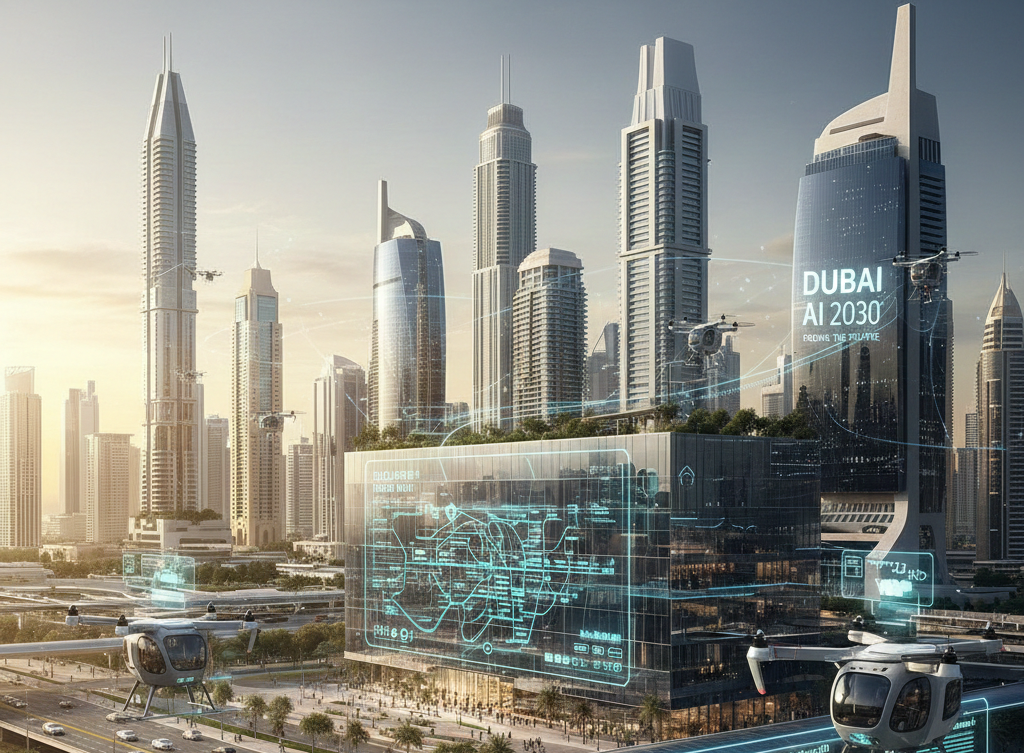
Revolution in Transportation and Logistics: Dubai aims for 25% of all urban trips to be fully autonomous by 2030. This project includes driverless electric taxis, smart metros, and even passenger drones (eVTOLs). To achieve this, the city requires a “Digital Twin”—a live, 3D model that processes traffic, weather, and obstacles in real-time to command the autonomous fleet.
Anticipatory Services: In traditional models, citizens must request services like passport renewals or school registrations. In Dubai 2030, AI will analyze “UAE Pass” data to initiate processes automatically before documents expire or a child reaches school age, notifying the citizen of the result. This effectively eliminates “queues” and “waiting periods.”
Smart Policing and Security: Utilizing Predictive Analytics to identify crime hotspots before incidents occur. By analyzing behavioral patterns across the city, these systems help police forces optimize their physical presence.
Knowledge-Based Economy: The ultimate goal is to reduce reliance on oil revenues by replacing them with exports of software, cloud services, and AI technical expertise, aiming to add $10 to $15 billion to the GDP annually.
Strategic Challenges: Navigating the Digital Minefield
Becoming a digital utopia involves more than just installing sensors. Dubai faces challenges that could seriously threaten the success of this plan:
A) Cyber Sovereignty and Centralized Data Security: When every aspect of an individual’s life—from medical records and financial history to traffic patterns—is aggregated into a single platform like UAE Pass, the security of this database becomes a matter of “national security.” A simple cyber breach could paralyze all city services. Dubai must allocate massive budgets to develop AI-based cyber defense systems capable of identifying and neutralizing attacks in milliseconds.
B) Global Talent Acquisition and Retention: AI requires “masterminds.” While Dubai has created an attractive environment through “Golden Visas” and tax exemptions, it remains in fierce competition with Silicon Valley, London, and Singapore. The main challenge is transitioning Dubai from a “technology consumer” to a “technology producer,” which requires deep reforms in the educational system and the creation of freer research environments.
C) Environmental Sustainability and Data Center Energy: Advanced AI models require immense processing power, which generates extreme heat. In Dubai’s desert climate, where temperatures reach 50°C, keeping massive data centers cool requires staggering amounts of electricity. Dubai must find ways to power these centers with solar energy; otherwise, the dream of a smart city will clash with environmental sustainability goals.
Explosive Opportunities for Tech Startups
Dubai has currently become the world’s largest Living Lab. For entrepreneurs, this city is a market where the government acts as your “First Client.” The following sectors are hungry for innovation:
EdTech: With the changing structure of jobs, there is an urgent need for smart learning platforms that can reskill the current workforce for AI interaction.
AI in Smart Energy Management: Startups that can use IoT (Internet of Things) to optimize electricity and water consumption in Dubai’s massive towers will face multi-billion dollar government contracts.
Edge Computing: Due to the speed requirements of autonomous vehicles, data processing cannot occur in distant central servers. Developing hardware and software that perform processing at the “edge” (near the device) is a vital necessity.
HealthTech: Using AI for early disease diagnosis through wearables and providing remote healthcare services that are fully integrated with the government system.
Dubai’s Competitive Advantage: Why the Odds are High
Many world capitals are bogged down by eroding bureaucracies, outdated laws, and civil resistance to change. However, Dubai possesses three unique characteristics:
Centralized Political Will: Strategic decisions in Dubai move from idea to execution with staggering speed. Here, bureaucracy is not an obstacle to innovation, but a facilitator.
Specialized Free Zones: Areas like DIFC and Dubai Internet City allow international companies to operate under familiar Common Law and 100% ownership in a secure environment.
Sovereign Wealth: Large Emirati funds have shifted focus from traditional real estate to AI and biotechnology, providing abundant liquidity for pioneering startups.
Final Analysis: Will 2030 Become a Reality?
Fully realizing an AI-driven city by 2030 is an incredibly difficult goal. The primary challenge lies not in technical limitations, but in building public trust and protecting against cyber threats. However, Dubai has proven over the past decades that it has a special expertise in turning the “impossible” into “reality.”
For startups and international professionals, Dubai is no longer just a place for trading goods; it is a base for coding the future. If the world moves toward “autonomous cities,” Dubai will undoubtedly be the Beta Version of this future.
Dubai’s future is being written in programming code, not in oil wells.
Frequently Asked Questions (FAQ)
1. Does going paperless mean the complete removal of human interaction in Dubai’s offices?
No. The main goal is to eliminate eroding bureaucracy and “repetitive tasks.” Government employees, instead of checking physical documents, will focus on solving complex issues, creative service delivery, and providing expert advice to citizens. AI is a “human assistant,” not a replacement.
2. How does AI help with Dubai’s traffic and pollution?
Dubai is implementing adaptive traffic control systems that analyze real-time satellite and camera data to adjust traffic light timings and suggest alternative routes. This leads to a 25% reduction in travel time and a significant decrease in carbon emissions.
3. Can non-Emirati startups participate in these projects?
Yes, absolutely! Through programs like Dubai Future Accelerators, Dubai invites startups from around the world to provide solutions for real challenges faced by government entities (such as Dubai Police or the Health Authority). If the pilot is successful, the government directly invests in the project and implements it city-wide.
4. How is personal data security guaranteed in the integrated “UAE Pass” system?
Dubai utilizes military-grade encryption standards and Blockchain technology to ensure data security and transparency. The system architecture is designed with layered access; an administrative clerk only has access to information necessary for their specific task, not the individual’s entire history.